Recently i got to know a charbor. Ok not say very chio, mai hiam buay pai type, can say slightly above average. Anyway after some initial chit chat here and there we went out twice. Also not say dates lah, just go out makan, watch a movie and walk around orchard road like thousands of other couples or couples-to-be... you look at me i look at you, checking each other's couple out hahaha.
So i admit a bit interested. Then i got her MSN and once a while we will talk cock on MSN. She already graduated and started working. Then recently on MSN the topic went into politics...
on NKF and Temasek...
Me: it is very unhealthy when the wealth of a nation is concentrated in the hands of one family, worse they seem to have something to hide, so unwilling to reveal anything
Her: as long as our cpf is there, with good interest rate, that's good
Me: isn't it better to be transparent if there is nothing to hide
Her: well if they r not public they r not oblige to give full report
Me: exactly like nkf isn't it? these r warning signs lor
Her: if u ask me, i think a corrupted govt eg philipines if they have a chance to have a company like gic, sure all the money will be gone and they will blame the downturn and say something they can't help it but i can see gic is continually making progress with new people and new investment opportunities
Me: .........
Her: i think i trust the lee
Me: right now no one even knows how GIC is doing, whether they r making or losing $$
Me: same goes for temasek
Her: true there is lack of transparency but to infer there is something to hide like nkf, that's very mean thing to say
Me: again if there is nothing hide, defend yourself, open your books for sgians scrutiny
Her: maybe they take high salaries and are not making money, and too embarassed to show
Her: they dont want people to be worried and disappointed
Me: rubbish then they r treating us like kids
Her: but you know gic is really run by top people from different discipline, not like nkf
Me: accountability means if u r not up to the job, u quit and someone else better do it
Me: i dun see ho ching quitting after all the bad biz decisions
Her: and let who take over? who can guarantee 100%?
Her: with such huge reserves, only can trust the elite and the honest
Her: i think that's why lky makes himself the chairman
Me: plse lah where got guarantee 100% profitability in the universe?
Me: let who takeover? how about george soros? how about waren buffet? they are world best and all proven men
Her: but those on board are also proven man
Her: tony tan is, so is dhanabalan
Me: (really buay tahan liao...) hey i go take shower liao :)
Her: ya sure
Me: bye
Her: yep bye
(end of session)
another time, on LHL...
Me: without his daddy he will never be PM
Her: well he is quite capable lah
Me: maybe capable as a bureaucrat, but as a politician and leader he cannot make it
Her: u sound like anti pap leh
Me: of cos i am, i belong to the 33.3
Her: what's that?
Me: the 33.3% who voted opposition
Her: oic
Her: with philip yeo in charge of biomed, the govt should have no worries
Me: philip yeo? HAHAHA!
Her: philip yeo is very capable leh, see what he did with edb
Me: i think we change topic lah, some things no point talking about
Her: what's wrong with philip yeo?
Me: oh many things wrong with him
Her: why he stepped on your toes izit?
Me: he stepped on all male sgian toes when he said male sgians are wimps! fuck him lah
Me: ah forget it lah
(end of 2nd chat session)
Last week we chatted on msn again and she wanted to come out watch movie, but i gave some excuse say not free. Then recently whenever i see her online i quickly go hide and put my status to offline. Dunno why all of a sudden very sian, no mood to talk to her liao. I dont think i want to take this relationship any further lor... I don't think I can carry out a normal conversation with a 66.6 anymore. Its really just a waste of time. And Derrick says the scary thing is dat many Sg gals are lidat... ignorant about current and world affairs. And most of them will vote for PAP. Progress Package can sponsor their latest dress and makeup they damn happy liao... fucking hell!
Tuesday, January 30, 2007

Friday, January 12, 2007
NUS don slams new media
This is an excerpt from a news article in the nation-building newspapers.
New media: Why young can't tell good from bad
Critical thinking skills lag behind speed of tech changes: NUS don
By Ken Kwek
When young Singaporeans surf the internet, many are unable to discern the good from the bad and ugly, said a media lecturer.
Often they are also ill prepared to defend what they post on the Internet, said Miss Lim Sun Sun, an assistant professor at the NUS.
This inability to process and analyse the content of new media such as the Internet can be traced to one factor - their critical thinking skills.
While many know how to use the Internet, many have not learnt how to think critically of the flood of information they encounter daily on the worldwide web.
The job of improving media literacy, she felt, should be a focus of the Government, the media and schools.
A member of the audience asked why there was a particular need for such instruction now, more than in the past. Prof Lim's reply: because there is a "growing atrophy" in students' critical thinking skills, a situation which suggests media literacy lags behind development of new media technology.
I don't know what they are teaching students at NUS, but this Ms Lim does not sound like a lecturer who knows how to teach.
1st of all, media literacy is always going to play catch up with media technology. This was the case 1000 yrs ago and this is the case today. The media puts something out, people consume it. That is the nature of the media, you become more or less literate as a result of media, not the reverse. Therefore I think it is more accurate to say that media literacy is dependent on the state of the media. This is especially so when the media in Sg is a tighly controlled and regulated one. However Ms Lim does not seem too concerned about this.
2ndly Ms Lim says that many "young sporeans are not able to tell good from bad" when it comes to the internet. I wonder how she makes this conclusion. Becos the same could be said for older sporeans too who can't tell the good from bad, the truth from the half-truths in traditional media. Are the old anymore media literate than the young? Here Ms Lim seems to imply traditional media is naturally credible and good by default - a standard PAP gahment view...
Then the question from the member of the audience to Ms Lim is a very good one: why all of a sudden this concern with critical thinking skills now? Why not in the past? Ms Lim's 1-line answer "because there is growing atrophy in critical thinking skills" sounds really lame to me & doesn't say anything. She does not attempt to justify herself neither does she explore the underlying reasons behind this atrophy thing that she invented. Being an educator shouldn't she be asking these questions? So if we take a step back and look at what she says... do we see any signs of critical thinking skills in all she said? Where is the analysis and defending of her own statements? I dun think she really understands what critical thinking skills is about.
Well maybe Ken Kwek the reporter was not given enough space to write a fuller article that gives a more complete picture of what Ms Lim said. But hey that would mean this traditional media is far from 'good' and credible right? Hahahaha!
The overall impression i get is a familiar one, that once again some people are trying to paint the new media as a threat. That instead of letting you think and decide for yourselves what is good and bad, they feel the need to dictate and decide what is good for you. Keep going on like this how not to atrophy critical thinking skills.
Thursday, January 11, 2007
Thoughts on Ah Gayle
Gayle Goh's language skills put me to shame. She is also a debater. Once a while i will pop over to her blog to see see look look. Wah lan she is not that much younger than me, but makes hell of a lot more sense than myself and all those sillyzens out there. I think NS and SAF really screws up a person's brain and thinking. Just look at those jiat liao bee paper generals now masquerading as politicians and CEOs. No wonder PAP wants more women in politics. Of course our PM is an exception.. bcos his NS is not really the same NS that ordinary Sporean males go through... hehe.
Anyway back to ah Gayle. Recently she appear on a mediacock show call BlogTV. I only knew about it (and the show) bcos i also drop by Mr Wang's blog, otherwise wtf is BlogTV who knows or care? Which goes to show how successful the TV show is, hahaha. To cut a long story short, Mr Wang declined to go on the show but Gayle did. And then Gayle wrote in her blog the reasons she did so which sounded to me like she tried to defend her actions, also at the same time she gave Mr Wang her opinions why engaging the enemy is not such a bad thing and so on, which in turn attracted replies from other bloggers, some agreeing with her and others don't. There is just too much blogs to read and comments to go through. But it got me thinking about people like ah Gayle and Mr Wang.
It wasn't that long ago i was in JC too. Family is middle class, no worries of the future. And then i sat for my A levels, didn't do too well, couldn't get into the local unis, so now have to look for study opportunities in private education providers. Of cos before that i kena conscripted into the CCB NS for 2 fucking yrs. I can say in the past 3 yrs i have "grown up". My thinking now compared to JC and pre-NS days are almost 180 degrees different. NS and working part time now shows me the kind of lives other sporeans lead other than my privileged one. Some things i witnessed myself also played a part in this "growth". So idealism is still very much in ah Gayle and this is what makes her attractive to the PAP who is now going all out to recruit and co-opt people like them.
Ah Gayle is not wrong to think that engaging the enemy is a constructive way to make changes. In fact her thinking is probably very close to political parties like the Workers Party and people like Chiam See Tong. Their approach is to try to survive within the current PAP-set system no matter how bad the odds are stacked against them and how ridiculous they are made to look. 忍辱偷生 comes to mind. The threat of unjust legal actions and invisible OB markers made them self censor and not say too much. I personally think in the long run such an approach will do more harm than benefit to the political health of this country. If today you cannot stand your ground and say what is on your mind and you back off half a step, it is only a matter of time before the day comes when you totally shut up. Maybe they dangle some carrots to make it easier for you to swallow. It is what some people call the slippery slope. The gentle and reasoned approach does not work with the PAP, which is a party founded on pragmatism and not ideology. The history and actions of PAP tells us that it only listens to those who has a bigger fist and heavier punch than them. LKY himself, whenever he is confronted with charges of authoritarianism and draconian acts, will not try to reason things out but instead just deflect them by saying "hey! get organised and challenge me, i'm not stopping you am i?" Of course if you take that bait u give him reasons to humtum you with his despotic ways. So i really do not think engaging the PAP, under the current political and social circumstances imposed by the PAP, will amount to effective changes. In fact if u engage them u risk losing credibility and let them run you down. Why play a game that is defined and set by them? Why not play your own game instead. I only agree with LKY on one thing and that is yes get organised, do something, but do something of your own and not the something they want you to do. The new media is forcing the PAP to bend to it, but the PAP is very smart and resourceful and it is now trying to subvert or control this media.
Mr Wang on the other hand is an interesting case. He is obviously much older, has more life experience and appears to hold a good job that pays very well. He is also a lawyer and ex-public prosecutor. His profile fits that of an elite as defined by the PAP. I consider him a moderate. And most of the time I agree with Mr Wang's take on things. But like an older person Mr Wang is also harder to read. One can only judge such a person by their actions. Same as how one should judge the PAP. By their actions and not their pretty and high sounding words.
Mr Wang is right not to attend the show. There is just too much to lose and nothing to gain. The time for engagement has past long ago. If you put something in place, then you also have to be the one to undo it. This is what the PAP has to do before people will come forward. It has to undo what it did in the past. Otherwise you cannot move forward in a meaningful manner. This is call accountability - a word i really like though i hate A level accounting hahaha! Going forward without facing up to the past, sooner or later the past will catches up and undo all your good work. I consider LHL no different from LKY, so in this sense Spore is still stuck in the LKY era. This is another reason why the PAP is targeting the young, bcos the young does not know and remember the past. So it is easier to co-opt them without having to be accountable. In Spore there is no lack of old or elderly people who are capable and can contribute to either politics or society. But why is the PAP sidelining them? I think the answer is obvious.
So all i can say is ah Gayle is young and no different from any 18 yr old. Too much is expected of her. If today she appears to have gone over to the dark side bcos she sincerely believes that is the way to make changes (and not bcos of carrots and goodies) or maybe she jus wants to have a bit of fun on TV, than so be it. Her actions in the future remains to be seen.
Wednesday, January 10, 2007
Another eat shit letter...
from the usual por lumpar sillyzen. Here is how the fuck face look like. Don't know why but all PAP types really cannot make it. Like my mum always say 全部贼头贼脑,祖宗背景不好 hahaha! Anyway the issue is about the lack of enforcement on smoking at coffeeshops brought up recently by the papers.
Consider suspending the licences of coffeeshops that let customers smoke
Letter from Ace Kindred Cheong
Two months ago, I was having supper at Henderson Coffeeshop and was disappointed to find many diners violating the smoking ban.
I was even more disappointed to see parents smoking while their children, some as young as six or seven, were seated and eating next to them.
I agree that there are not enough NEA officers to enforce the anti-smoking laws at every coffeeshop.
But to send a strong message to errant coffeeshops that conveniently turn a blind eye to violators, why not consider a suspension of their business licences if warnings and fines fail?
Doing so will shame and educate those who do not abide by the law.
Anyone who takes public transport will also know that smoking is banned at bus stops even before the ban at coffeeshops took place, but today we still see people puffing away without a care. Personally I think the law is a good thing except for the part on enforecement. If the gahment wants to come up with a new law it should also have the means to enforce it. Otherwise it is just all sound and fury,虎头蛇尾,a half fuck measure typical of the SAF. But the most ridiculous thing is they play tai-ji and pass the buck to the coffeeshop owners, saying it is the owners' responsibility to enforce on customers. And here our shit brain Ass Cheong chipped in as usual to agree. KNN if not enough NEA officers is it the fault of NEA or the fault of the coffeeshops? Why is the gahment passing the buck to others and expect others to do the job for them? Like that coffeeshop owners need to employ more staff, overhead goes up, then how? You going to pay for that Mr Ass Cheong? Don't make any fucking sense.
What about people smoking at bus stops? Why not talk about fining and shaming LTA since LTA as owners also do nothing and turn a blind eye to smokers? LTA didn't enforce leh, so how Mr Ass Cheong??
Thursday, January 04, 2007
Stupid Grace
Sometimes I wonder at the amazing stupidity of some S'poreans...
Jan 4, 2007
No cause to doubt credibility of HDB
I do not think that it is justified to press the Housing Board for its land and construction costs or doubt its word that the flats are subsidised.
In the first place, Singaporeans are not obligated to buy HDB flats. If they suspect that the flats are not 'at market price', they can buy private apartments.
She reminds of Marie Antoinette. "Oh you are without food? How about some cakes then?"
However, the ongoing demand for the flats speaks for their market value. If a comparison were to be made, private apartments are still beyond the reach of the majority of Singaporeans.
Secondly, in view of the subsidy, owners should sell their flats back to HDB if they want to upgrade. However, HDB is good enough to allow owners to sell their flats in the open market and make a tidy profit.
What the fuck is she talking about? Anyone think she is making sense here???
Thirdly, the flats have improved in design and size since they were first built. If the flats are not 'at market price' and therefore unattractive, why are some Singaporeans using the names of their siblings, aunts and uncles who are still single to purchase these flats with the intention of selling them later?
I voted for a government which is trustworthy, honest and capable in every sense of the word and I have no cause to doubt the credibility of the HDB.
In fact, I appreciate what the Government has done to house poor Singaporeans like me in the 1960s when we were desperate for a roof over our heads during the Indonesian Confrontation.
Today, our housing system is a pride of the nation. It is unfair to throw brickbats of any kind at the HDB when it deserves bouquets.
Grace Cheah Gek Neo (Miss)
People like Grace Neo who is so trusting of everything, is like an ostrich with its head in the sand. I wonder is she just another elite who is out of touch with the real world? No one doubted Durai and his NKF, but look what was really going on? Grace Neo is what my friend Derek will call a 愚民 (stupid citizen), or a sillyzen. These people will be death of this country.
Monday, January 01, 2007
2007 is here
Happy new year!
ORD is sibei song! But it is also the beginning of reservist... fucking hell the system really makes a slave out of the s'porean male. Go die lah chao cheebye...
ORD is sibei song! But it is also the beginning of reservist... fucking hell the system really makes a slave out of the s'porean male. Go die lah chao cheebye...
Saturday, December 09, 2006
S'poreans First? Just a smoke screen lah
Still on the health care topic, recently mini Lee announced that very soon medical and education subsidies for PRs and foreigners will be reduced. According to him it is about time we "put Singaporeans First".
Of cos the 1st thing dat comes to my recruit mind is "oh! so all this while u put Sporeans where ah?" Second, third, or fourth?? So now we know! HAHAHaha mini Lee slap himself again!
TODAY got this letter and IMO the person has got it right. I am just going to highlight some parts of the letter...
Gap in citizen logic
Improving S'poreans' welfare without cutting PR benefits may be a better approach
Letter from Ran Xia
I refer to the recent letters debating the new policy for foreigners to pay more in certain essential services, in particular Mr Chia Hern Keng's letter, "Not robbing Peter to pay Paul" (Dec 8), which has untangled the issues and helped clear the air.
Under the new policy, foreigners, including Permanent Residents (PRs), have to bear a higher cost of living — by paying more for education and healthcare — while there is no indication that citizens will pay a single cent less.
Moreover, local employers may have to absorb the additional costs to attract foreign talents. Neither foreigners nor citizens are likely to get any real financial benefit. Some citizens may get the impression that they will pay less because they are Singaporeans, but the size of their bill will remain the same.
(blah, blah, etc)
It is not meaningful to stretch the debate based on who needs who more, or loyalty to the nation. We need one another in this globalised world, while citizenship — either by birth or conversion — does not necessarily guarantee loyalty.
I think the original intention of this new policy was to create a "gap" between PRs and citizens to encourage more foreigners to take up citizenship here.
Let's think in reverse: Wouldn't it be more sensible to increase the welfare of citizens rather than take away what PRs have now? This serves the same purpose but definitely makes citizenship more attractive.
Under the PAP gahmen, prices go up liao will never come down one. Helping to reduce the cost of living is like slicing a pound of flesh from the PAP elites' flesh. WTF man! So once again instead of addressing the root causes of why medical costs and so on are escalating like nobody's business, they chut this pattern saying "see! someone will suffer more than you leh, so better shut up." WTF??
Instead of improve things for Sporeans, they make it worse for another group, as if that will somehow make Sporeans happier and lighten our load?! The logic behind is really KNN man... It is like the GST hike lidat, transfer the burden from the rich to the poor. So it is the same thing here, transfer the burden from Sporeans to non-Sporeans. And who knows maybe along the way the gahmen keep some for themselves! Raise bonuses and ministerial salaries!!
This is precisely why limpeh is skeptical. Becos the GST hike is very unpopular and hard to swallow for Sporeans, so mini Lee needs to placate Sporeans. So throw out this "Sporeans First" bullshit smokescreen. Besides, it is always very effective to play up nationalistic sentiments that put Sporeans vs Non-Sporeans. It is nothing more than a political move rather than a genuine attempt to put Sporeans first.
Thursday, November 30, 2006
Honest mistake means not accountable?
A piece of news today... i wonder if this is part of the penal review?
Here is the bit i am skeptical about...
Starting next year, an initiative by Chief Justice Chan Sek Keong could change the complexion of medical negligence cases. All parties can meet before a case begins; patients or their relatives can find out exactly what happened; and, if necessary, doctors can say sorry.
More importantly, everyone can speak freely, because the information exchanged cannot be used in court.
1st thing that cross my recruit brain is... WTF? Imagine i am a doctor suspected of negligence or misconduct.. If i tell you something that you deserve to know, you then cannot use those information if you later decide to pursue an action against my negligence? I mean if a doctor wants to say sorry sincerely then just say it. Why should there be conditions tied in? Of coz if the doctor does not believe there is any negligence, why force the doctor to say sorry? A negligent doctor sooner or later must face the truth and consequences. Why should a doctor be somehow protected? Now it appears that in a case where there is genuine negligence, and the doctor knows it, but by using 'sorry' and 'honest mistake' you can't hold him/her accountable anymore. Can lidat one meh??
This leads me to think about this. According to the news...
In fact, experts said that if the move takes off, there could be less need to go to court at all. The air of mistrust can be cleared, and if an honest mistake has been made, the matter can be settled without relying on expensive litigation.
So expensive legal fees and proceedings is the reason behind this. But straight away there is a loophole. If i make the already expensive litigation even more expensive, wouldn't this push people (especially the poor) towards this new policy? Haha you see anot? Who will actually benefit and be protected??
The question is in the first place why is litigation so expensive?? This means justice lies with those who can afford it instead of those who really needs it. Why not address this to make litigation affordable for all?
If this is part of the law review or whatever review they are doing now, it seems to me once again it is designed to favour the rich and elites.
Wednesday, November 29, 2006
The PAP is clueless, here is an example
Ever since news of the GST hike, it is normal for the PAP controlled 146th media to follow up with por lumpar articles and "expert views" on how the GST hike will benefit SG and S'poreans etc. Here is one from last week.
I leave the details aside but in a nutshell it says the GST hike will help serve the long term needs of S'pore by attracting more foreign talents and foreign investments.
What is this thing about foreign investments or FDI (Foreign Direct Investments)? No doubt foreigners and FDI did play a vital role during a period of SG's development. But even a chow recruit like me knows that it just does not make sense to keep relying on it. Sooner or later it will harm us more than it help us, like an unhealthy obsession or something. I remember my parents talking about it back in the 80s when i was just a ginna pi. And now in 2006 we are still talking about FDI. It is like ingrained in the national psyche! Of cos the reason we hear so much is becos the PAP talks about it all the time (remember GE 2006?), and now we hear it again to support the GST hike. Endlessly we are told, FDI is good! We need FDI! Without FDI it's the end for you and me!!! (according to the PAP at least)
Of cos the critics think differently. I remember during GE the Workers Party and their non-elite types question the holy grail call FDI. Nabei hor, how dare they question the elites?! Even CSJ, who is not trained in economics, was one of the first critics of PAP's economic policy! I'm sure we cannot listen to CSJ?! The man is mad according the PAP and their media... We must instead listen to our economics wonder, none other than LHL!
But today the truth is finally out. The bullshit about FDI has been debunked by Harvard economics guru Michael Porter. Basically Porter confirms what our oppositions have been saying all these years. "The old formula doesn't work anymore," he says, becos the growth drivers of the past have reached their limit...
1. FDI - S'pore already has the highest FDI intensity in the world. It would be hard for it to go up any further.
2. Singapore's trade — another evergreen driver — reached a point where its size, at $715 billion, was greater than the Republic's $194 billion Gross Domestic Product. It is unlikely the trade sector will grow further.
3. Efficiency - that other buzzword — sounds jaded now. S'pore can no longer compete on being just an efficient place to do business. Increasingly, it has to be a knowledge-based, differentiation-based, innovation-based economy. (And Porter stopped short of pointing out we have yet to make that challenging transition.)
4. And finally, the era in which Singapore's Government could drive its economic development was passe. "Top down from the Government is not working any more," Porter said.
So what do we have to do now? Porter's answers lie in ...
1. A bottom up approach instead of a top down approach.
2. Mobilising the private sector. In other words the small and medium enterprise (SME) and building indigenous capabilities. (dats right! the FT policy is misguided!)
In other words exactly what the oppositions have been calling for all these years. Wow! Our non-elite opposition got world class intellect leh! KNN then how come all the PAP million dollar morons still talking about FDIs and FT crap. They bloody sleeping on the job all these yrs issit?! KNNBCCB!!
So u see the next time you hear some PAP dogs bring up this FDI thing again, you know the person is really an outdated unthinking moron living in the past.
I used to be skeptical and wonder about the capabilities of LHL. Is he really that smart and brilliant like what the media say he is? Now i know there is no need to wonder anymore! After all the clue was there all along.... he was a SAF general, enough said, hehehe.
Tuesday, November 14, 2006
Chao Cheebye GST going up!!!
This must be one of the most cheebye news of 2006!
I am too fucking angry to post a link, instead I will just cut and paste some of the most fucking cheebye rubbish ever to come out from Ass Loong's mouth!
Speaking in Malay, Mandarin and English, Mr Lee explained that the hike was necessary to finance the enhanced social safety nets, needed to help the lower income group and he emphasised that the offset package would more than counter the rise in GST.
Hey fuck you Ass Loong! Can come up with a better excuse or not?! Your cheebye world highest PM salary take out and donate to help the poor lah motherfucker!!! You want to offset simi lanjiao? KNN typical SAF paper general style, LPPL, create extra work for the sake of looking busy!
While Singapore's current model to tackle the widening income gap is sound, Mr Lee said the government would take on two approaches to deal with the new environment - to strengthen the safety nets and tilt the balance in favour of the lower-income groups who do not benefit from the fruits of economic growth.
To do this, government spending will have to go up. The government now spends some 15 percent of its GDP - one of the lowest in the world.
What the fuck is this magic number of 15 percent??! Who decide one?? Why cannot spend more than 15%? How about increase to 20%? Like this won't need to increase GST right?! KNN see i have hit upon a solution liao, straight forward and simple, no need to create extra work for these dumb fuck civil servants.
And where is the rest of the 85%?? You makan shiok shiok liao ah?! Or throw into failed ventures overseas? Shin Corp??
"It's part of being one society. I'm not going to tax 15% on income tax, I'm not going to tax 25% from GST the way the Scandanavians do, but I have to make the adjustments of 2% which I think is fair and I think Singaporeans will support," added Mr Lee.
Hey Ass Loong, u forgot this is Uniquely Singapore ah? Why use other countries to compare?? This Singaporean here got this to say in your sissy face. "IT IS NOT FAIR AND I DON'T SUPPORT THE GST HIKE!"
KNNBCCB go to hell PAP!!!
Monday, November 13, 2006
The Law protects the Elites
I heard parliament came out with some Penal Code review. I won’t go into the details becoz bloggers out there do a better job commenting on it. Everyone has their angles. For example Yawning bread is concerned about discrimination on gays, or Mr Wang and many others are concerned about curbing freedom, free speech, public assembly etc.
However I find one big element that is glaring in this Penal Code Review. I notice all the changes to the law are targeted towards what I call Blue Collar crimes. They are going to make punishments harsher and fines heavier. But what about White Collar crimes? I see no mention of changes to White Collar crimes. Maybe there are but so far I don’t see any reports or news. And no bloggers touch on this angle yet.
So it seems the Law Review targets the weak and the poor and the masses. It doesn’t target crimes that elites are likely to commit. Example corruption, corporate fraud, embezzle money, graft and so on. Not even expanding the scope, I think the punishments also remain the same. So you see the elites are getting away with it protecting their own kind.
If I change the law and say from today onwards if you commit fraud or steal money worth more than a peanut ($600k), the punishment will be death sentence. Straight away I tell you there will be no more cheating and corruption. Deterrence mah, as PAP always like to use as justification.
And this will be very effective don’t you think? Instead of having to pay millions to entice people not to be corrupted, now those who want to try some funny business will seriously think hard before trying. And white collar crimes are committed by people who are smart and educated, so they should be able to use their brains and think. If they still want to go ahead and commit white collar crimes then they cannot siam and say things like “oh, it was a moment of folly”... or “I lost my head there for a moment” kind of lame excuses.
Just take NKF and Durai for example. He was a lawyer and knew the law. This kind of smart educated people is 知法犯法 so his punishment should be tougher than say someone who spoke without a public permit or a pickpocket. In fact the Penal Code Review should emphasize on people like them and their crimes becoz this kind of elites are rich, knows the right people, and can hire expensive lawyers to argue their guilt away. Likewise if a minister or MP is found to be corrupted or commit white collar crime than their punishments must be double or triple or even life imprisonment or death! If Durai and Mathilda knew that they will be hanged for stealing peanuts I’m sure things would be different. This is a good becoz it also serves as a filter and sieve out those whose hearts are not in the right places especially when it comes to public office.
But instead of being tougher on white collar crimes the gahment does absolutely nothing on this category of offenders. This goes on in S’pore all the time and is not a new thing.
Take the SAF for example, recruits and privates and NCOs are subjected to charge or sign extras at the whim and fancy of their officers. But what happens when a Captain does something wrong? It is rare that the Captain’s superiors (Major, Colonel etc) will want to destroy a fellow officer’s career. So it is usually a harsh verbal reprimanding for wayang, sign some harmless extras and after that covered up. Why not charge the officer?? Why not demote the bugger or throw him in detention barrack?? It is only fair that leaders who fail in their duties must bear heavier responsibilities. But we all know such is not the case.
So you see from the SAF to real life, there is always a class-divide. The elites look after their own not only becoz of self-interests, they do so and deliberately use the law to penalize the non-elites becoz they are fearful of the masses.
S’pore consistently ranks high on being clean and non-corrupt, but who are the people who are voting in such surveys? It is always the bosses, the elites, the foreigners etc who are least punished if they do something wrong. And if the law punishes a non-elite for causing offence to an elite, than all the better and S’pore must be a wonderful place to do business!
Saturday, November 04, 2006
Despot talk cock sing song again
The emperor keeps tripping and slapping himself, just that no one is pointing it out to him. Just look at some of what he said according to this news article.
Shorter-term leaders?
MM Lee says future leaders may not remain in office beyond 20 years
Derrick A Paulo
WHEN Minister Mentor Lee Kuan Yew visited the chairman of ExxonMobil last month, he was offered a glimpse of how Singapore may have to manage leadership succession in the future.
In Texas, the oil giant's headquarters were "so much more attractive than the White House", Mr Lee found.
"I then realised why the best leaders in America go to corporations, not into government," he said. "The attractions of a private career and a private life are stupendous."
Aha! But a career in public office is not the same as one in a private profit-driven corporation. To lump the two together shows a lack of basic understanding of what is public office. The starting point and motivations are different. I think he always wanted secretly to be a successful CEO and make it big in business, like Wee Cho Yaw and all that. But because he can't, so he installed himself as Chairman of GIC and play businessman there. Obviously he is not good at it, and must have wasted a lot of money in bad investments and failed ventures, which is why the books of GIC remains a secret and all hush hush.
It is a scenario Singapore may face in the next 20 to 30 years, if the economy keeps growing and the country is more secure financially. One solution to ensure that governance standards do not slip would be to give successive leaders shorter terms in office, believes Mr Lee.
Between 10 and 20 years — that is how long he hopes they will stay at least, "because you need two to three terms to really master the art of government".
But, any longer and the prospect of heading the Government of Singapore Investment Corporation — with offices across the globe — may become more appealing than heading the Singapore Government, said Mr Lee, speaking at the launch of the LKY School of Public Policy's inaugural book, Managing Globalization: Lessons from China & India.
However, he ruled out hiring "foreign talent" to run the country, after he was asked by a Singaporean student of the school if it was a possibility.
"No … you must have the passion, you must have the commitment, you must share the dreams of the people," he replied.
Aha! So in one big sweep he just condemed all who are not in public office as lacking the passion, commitment and don't share in the dreams of the people. So what about Temasek and GIC? They are corporations and not government. So now we know why Temasek is fucking up so badly in Thailand! Hahaha!
Although Singapore is grappling with a widening income gap, and globalisation has led to signs of a dual economy, Mr Lee believes that everyone can still gain from economic growth.
He likened the country's wealth distribution to a tennis or golf tournament.
"The big prize is always number one, then number two, number three, but in fact, all those who have participated do get something; otherwise, they won't come back. They have expended time and money, got their golf clubs or rackets," he said.
"It's important to give everybody a sense of having participated in the national effort. We reward you with a decent life. How much of a decent life will vary with how magnificent the result of the total effort."
The Government's approach is to keep seeking out the right balance between competition and compassion. "If you have too much of the yang, highly competitive, your society will have a certain amount of friction. If you have too much of the yin, you'd have lost your drive," he said.
Many of the school's international students among the 300-strong audience were hoping to hear Mr Lee's and Singapore's prescription of yin and yang for their own societies.
For him the bedrock of development is security, stability and a system that rewards learning and hard work. But he stressed that it was up to them to "get (their) countries in order".
While Singapore after independence "grafted" 70 to 80 per cent of its approach to government from good practices around the world, he estimated, the 20 to 30 per cent of local experience is no less important.
"I listen to all the advice I get … some unsolicited, especially from well-meaning academics. But you don't know me, and my conditions, and I know that's not applicable. So, we do what we know will work," he said.
So despot, you KNOW everything ah? KNOW, KNOW, KNOW, KNOW. What do you KNOW? Not only are you arrogant, you make yourself look stupid. No wonder your party is filled with equally arrogant idiots like your son, monkey Tan, Wee Siew Kim, Wong Cunt Sing, Ng Eng Hen, Lee Boon Yang etc... too many to name liao. Bloody worms all.
Monday, October 09, 2006
FEER October issue
From the Editor
October 2006
The Singaporean government’s recent decision to ban the REVIEW and the defamation lawsuits against us by its two most powerful politicians take us back to a time when the city-state was a poor speck of a country sitting on one of the fault lines of a fractious region. Besieged from without and within, the government of the young People’s Action Party resorted to Draconian colonial-era laws to crush dissent. Today, Singapore is an affluent and peaceful society with ample means to protect itself, and its Southeast Asian neighborhood has progressed from confrontation to cooperation. So why is it still using repressive measures against a monthly magazine that employs a total of three full-time journalists and has 1,000 subscribers in the country?
The July article that started this most recent dispute with Singapore, “Singapore’s ‘Martyr,’ Chee Soon Juan,” sought to raise a similar question, only it focused on the methods used to silence the leader of the opposition Singapore Democratic Party. We put it to Mr. Chee himself, and he laid the blame squarely on the country’s founding Prime Minister Lee Kuan Yew, who now holds the title of “minister mentor.”
The ruthless suppression of dissent must be kept up, he said, because as long as Mr. Lee is alive, a new generation of leaders is unable to emerge and distance themselves from his record. Mr. Lee’s past actions, which have led to human rights abuses and statist management of the economy, haunt the government. Mr. Chee believes that is the true reason dissidents like himself are hounded: “If we had parliamentary debates where the opposition could pry and ask questions, I think he is actually afraid of something like that.”
After the article was published, we received letters from Davinder Singh, a lawyer for Mr. Lee and his son, Prime Minister Lee Hsien Loong, claiming that these sentiments and several other sections of the essay defamed the two men. Mr. Singh demanded apologies, removal of the article from our Web site, and an undertaking to pay damages and legal costs.
We did not comply with these demands, and proposed instead to publish a clarification that the REVIEW did not intend the article to express the defamation alleged by Mr. Singh. After several rounds of correspondence with Mr. Singh, all of which is posted on our Web site www.feer.com, we heard nothing more for 10 days. Then the Singaporean Ministry of Information, Communications and the Arts announced new conditions to be imposed immediately on the REVIEW, requiring us to appoint a legal representative in Singapore to accept lawsuits, and post a S$200,000 ($126,000) bond to cover damages from such lawsuits—even those relating to already published articles—if we wished to continue circulating. This order had no basis in Singapore’s own law, which stated clearly that such regulations could be imposed only on publications that publish at least weekly or which have been found to have engaged in domestic politics. We have also posted all of our correspondence with the ministry on our Web site.
The timing and substance of this move were in our view no coincidence. It followed hard upon our refusal to apologize and pay damages. Moreover, to sue the REVIEW in Singapore, the Lees would have to serve the papers in Hong Kong, where the magazine is based, since we do not have any employees in Singapore. This means we could challenge that service and/or the enforcement of damages in Hong Kong.
With Singaporean efficiency, the government bureaucracy leaped into action on the Lees’ behalf, imposing conditions with retroactive effect in order to force the magazine to put its head on the block for the Lees to chop off. When the REVIEW refused to comply with these conditions, the Lees proceeded with their lawsuits anyway. This episode tells us much about the use of official power to chill free speech in Singapore.
The Lees’ court filings of Aug. 22, which we have posted on our Web site, claim that the REVIEW article carried the message that Mr. Lee Sr. is “unfit for office because he is corrupt.” We believe that no rational subscriber to this magazine would read the article in the way the Lees allege. Reporting an opposition MP’s claim that a leader’s policies may have led to human-rights abuses and the concealment of government errors is very different from alleging he is corrupt. Mr. Lee’s probity is legendary; we do not believe that his faults include personal corruption, and it strikes us as fantastical to allege that such an allegation was made by the REVIEW.
The lawsuits also make reference to the section of the article that notes “Singaporean officials have a remarkable record of success in winning libel suits against their critics. The question then is, how many other libel suits have Singapore’s great and good wrongly won, resulting in the cover-up of real misdeeds? And are libel suits deliberately used as a tool to suppress questioning voices?” The lawyer claims that this means that Mr. Lee Sr. “has set out to sue and suppress those who would question him as he fears such questions would expose his corruption.”
Mr. Lee certainly has an impressive record of suing his critics, as do other Singaporean officials, but since we don’t believe he is corrupt, we could hardly have meant that these lawsuits were intended to conceal corruption. Rather we asked the question, one that is legitimate and in the public interest, whether Singaporean officials have used libel lawsuits as a tool to suppress legitimate criticism.
Even defending oneself vigorously in Singapore can incur punishment. For instance, in a case involving a REVIEW article from 1987, a London queen’s counsel vigorously cross-examined the prime minister. After finding for Mr. Lee, the court awarded him aggravated damages in part because the barrister’s questions were calculated to “increase the hurt to his feelings.”
Finally, the Lees’ lawsuits against us allege that the REVIEW defamed them by referring to the scandal of the National Kidney Foundation and Chief Executive T.T. Durai. We noted that this case was exposed only because Mr. Durai, having prevailed in one defamation case, filed a second against a major bulwark of the regime, Singapore Press Holdings, which he lost. The obvious and legitimate question asked by the opposition is, how many more Durais are there in Singapore officialdom who are getting away with abuses because of the lack of an independent media and a vigorous opposition?
Corruption undoubtedly exists in Singapore, as the National Kidney Foundation scandal shows, but asserting this is not a slur—no country is entirely free of this taint. The key thing to watch is whether a government uses sunlight as a disinfectant, or sweeps its errors under the rug. Singapore’s use of press restrictions and politically motivated libel actions makes us wonder whether its reputation for clean government is deserved. For instance, in July, Minister Without Portfolio Lim Boon Heng encouraged the local media to focus more on good news and stop trying to uncover abuses: “If you want to do investigative reporting, there must be something which is wrong which has not been attended to. I think there are not many issues in Singapore that fall under this category.”
Mr. Lim’s words reflect Singapore’s deliberate program to neuter the domestic and international media. Over its 60 years, the REVIEW has often borne the brunt of this campaign. In a 1995 column for the Independent newspaper, the late Derek Davies, a former editor, recalled that in 1976 Mr. Lee Sr. threatened the magazine with ruin if it commented on sensitive matters. Then in 1985, Mr. Lee confided he had a new plan:
“He told me that he was determined to set things straight with the foreign press before he handed over power to the younger generation,” Mr. Davies wrote. “He was drafting a new press law aimed at the pockets of owners and publishers, not editors. If any publication was deemed to be ‘engaging’ in Singapore’s domestic politics, its circulation (and its profits) could be cut to a trickle, while denying it the right to claim it had been banned.”
The new law was passed in 1986, and as a commentator noted in the Times of London the following year, there was little doubt what engaging in domestic politics meant: “As a rule of thumb, any article with which Singapore disagrees and which does not carry its views is deemed to be an interference in its internal affairs.” It wasn’t long before the REVIEW fell afoul of the stricter standard. In 1987, Mr. Lee sued for libel over its coverage of the detention without trial of Catholic social workers, claiming he was portrayed as intolerant of the church and religious freedom. The government restricted the REVIEW’s circulation to a tiny number, and when Mr. Davies withdrew all distribution, it pirated the magazine with the advertisements blacked out.
Sadly, the government’s efforts at controlling coverage of Singapore have been largely successful. For local journalists, whose coverage is controlled by the government through Singapore Press Holdings, resistance is futile. And given that Singapore represents an important market for media in the region, many foreign publications are wary of offending the government. Correspondents who want to tackle controversial subjects find that even carefully nuanced articles involve so much back-and-forth with the lawyers that the effort hardly seems worthwhile. When something critical does make it into print, the appearance of a letter from Mr. Singh demanding an apology and damages has in recent years too often resulted in immediate capitulation.
We respectfully submit that balanced coverage of Singapore in the international media requires deeper reporting and tougher analysis of government actions, as well as an occasional opportunity for opposition politicians to speak for themselves without fear of financial ruin. This is one reason for the REVIEW’s decision to defend itself against these latest defamation suits.
In this issue, academics Michael Barr and Garry Rodan take on two taboo subjects in Singapore: the racial composition of its educational system and the government’s control of the local media. Mr. Barr examines whether Singapore’s claim to be a meritocracy stands up to scrutiny given the striking inequality between the races as shown by the educational advantages enjoyed by ethnic Chinese. Mr. Rodan looks at how the government controls the flow of information for the purpose of protecting and reinforcing the founding myths of the PAP regime.
These articles go straight to the heart of some of the most sensitive issues the Singapore government doesn’t want discussed: race, language, religion and culture. These topics are sometimes said to be “out of bounds.” As Mr. Lee Sr. once explained, “They are not cerebral matters which we can discuss in a Western salon. In our society, these are visceral matters. People take their religion very seriously. It is extremely dangerous to treat this just as another conversational subject.”
Mr. Lee apparently still sees the country he shepherded to independence as fragile and vulnerable. Yet having enjoyed almost 40 years of PAP rule, Singapore has had plenty of time to tame its ideological and racial demons. If after four decades the society remains so volatile that one can’t even discuss sensitive topics openly, the government must have failed in its duty to build a harmonious society.
We don’t think that’s the case. There is much to admire in Singapore’s development under the PAP, and the REVIEW has a responsibility to its readers to provide a balanced view of this record. When honest criticism is forbidden, however, balance is hard to attain. We come back to Mr. Chee’s appraisal that the real impediment to Singapore’s emergence as a self-confident, pluralist society is Lee Kuan Yew himself. After all his contributions, the minister mentor is tarnishing his legacy with attacks on the REVIEW, the international and regional press, Mr. Chee, and others who pose no threat to Singapore. We believe most Singaporeans recognize this and yearn for a fully free democracy. We look forward to that day, when we hope the REVIEW will circulate in Singapore once more.
H.R.
FEER strikes back!
Singapore’s Founding Myths vs. Freedom
October 2006
By Garry Rodan
The Singapore government hoped for significant returns when it invested approximately $85 million to host the September 2006 meetings of the International Monetary Fund and World Bank. And this seemed like a reasonable expectation. After all, the 16,000 delegates represented a captive audience to promote the Singapore’s finance and tourism industries.
What transpired, however, was a public-relations disaster for the ruling People’s Action Party. Singapore’s extensive curbs on political expression were to consume much of the international media attention before and during the meetings.
Home Affairs Minister Wong Kan Seng warned that public protests may “attract severe punishment, including caning and imprisonment.” Under Singapore’s Public Entertainment and Meetings Act, a security permit from police is required for more than four people to gather in a public place. Authorities claimed that outdoor protests would disrupt local residents and could be exploited by terrorists.
Far from winning new admirers by hosting the meetings, Singapore’s authorities managed to alienate existing ones. Leading American neocon Paul Wolfowitz, now president of the World Bank, slammed immigration restrictions on activists as “authoritarian.” Mr. Wolfowitz accused Singapore authorities of reneging on a 2003 agreement to allow attendance of accredited activists, adding: “Enormous damage has been done and a lot of that damage has been done to Singapore, and it’s self-inflicted.” Belated approvals for 22 of the 27 banned activists to enter Singapore limited—but didn’t undo—the damage.
Many international NGOs conducted their activities from the nearby Indonesian island of Batam. Meanwhile, international media attention turned to the attempted illegal march and rally by Singapore Democratic Party leader, Chee Soon Juan, and six others to highlight curbs on freedom of speech, association and assembly. Encircled by 30 police, the protesters were physically prevented from even beginning their march from a city park. Without taking a single step they had proven their point and the government’s contempt for voices of protest was vividly projected to the world.
Additional limits to political expression in Singapore are imposed through stringent media regulation and frequent litigation by government leaders. None of this is abating. Indeed, this publication was recently banned in Singapore, as editor Hugo Restall explains in this edition. But why does the ruling PAP persist with such tight controls over expression given that it enjoys widespread political support inside and outside Singapore? How can we understand the sorts of pr disasters described above?
Any attempt to answer these questions needs to grasp that suppression of dissent in Singapore is discriminating. The PAP has over the last four decades displayed special anxiety toward certain criticisms and scrutiny, while it is less severe in its reactions to others. In particular, it reacts robustly to questioning of the PAP’s governance virtues and the integrity of the political, legal and bureaucratic institutions it has crafted. It is especially protective of two foundational myths of the PAP, which provide the rationale for the ruling party’s monopoly of power.
The first myth is that public institutions are autonomous, efficient and administered by a meritocracy. In this construction, the integrity of any institution is directly linked to the character of its officials and vice versa. The second posits that unless all politics is channeled through clearly defined and regulated formal political institutions then Singapore’s social and political stability will be at risk. This concept of politics is a compartmentalized and highly regulated one.
However, the veracity of such defining stories about the essence of the regime’s character and purpose are impossible to fully ascertain given the constraints on inquiry and debate into them. This is not by accident, since if these myths could not hold up to scrutiny then the rationale of the de facto one-party state would be undermined. Insulating these myths from scrutiny may reflect a lack of confidence in the ability of Singaporeans to assess competing claims about key institutions. It might also reflect a lack of confidence in the ability of the institutions to withstand critical scrutiny. Whatever the case, reinforcing foundational myths involves continual vigilance in monitoring and restricting public debate on PAP governance and institutions.
Paradoxically, dissent itself can actually be functional for the promotion and reinforcement of these myths. For instance, the high-profile defamation suits against critics not only impair or punish government opponents. These trials also avail the ruling party of opportunities to articulate the proclaimed attributes and qualities of the governance system. This explains what otherwise appears to be an inordinate scale of resources and political investment devoted by the PAP to such trials.
Similarly, the extensive system of licenses and regulations pertaining to any form of political expression enables authorities to do more than just limit such activities. It provides opportunities for authorities to echo political leaders’ notions about threats to social and political order posed by civil society activism, public rallies, Internet Web blogs and other independent political expressions.
PAP sensitivity to scrutiny of key state institutions goes a long way toward explaining why J.B. Jeyaretnam and Mr. Chee have encountered more difficulties than most opposition politicians. They are depicted as engaging in “gutter politics,” periodically contrasted for the worse with Singapore’s two opposition members of parliament—Mr. Jeyaretnam’s successor at the helm of the Workers’ Party, Low Thia Khiang, and the leader of the Singapore People’s Party, Chiam See Tong.
In recent decades, Messrs. Jeyaretnam and Chee have consistently probed, questioned and criticized various aspects of the governance system, honing in on the processes accompanying bureaucratic, administrative and political decisions. They have each endured a raft of problems with authorities in trying to conduct political organization and communication—including a string of defamation cases awarding massive damages to PAP leaders. These ultimately resulted in the bankruptcy of the opposition politicians and hence their ineligibility to contest elections.
The most recent demonstration of the difficulties in scrutinizing the PAP’s governance claims without being open to defamation allegations by PAP leaders was provided in the run up to the May 2006 general elections. Mr. Chee led an SDP campaign questioning the response time of the government to problems over disclosures and uses of public funds by the multimillion dollar charitable organization, the National Kidney Foundation. Any chance of a robust debate about the performance of the government and state regulatory institutions was blunted following legal suits by Prime Minister Lee Hsien Loong, Senior Minister Goh Chok Tong and Minister Mentor Lee Kuan Yew.
Questioning the associated meritocracy myth has proved especially hazardous for the international media. Examples of this include responses to articles by the International Herald Tribune in August 1994 and Bloomberg in August 2002, respectively seen to imply nepotism in the political rise of Lee Hsien Loong and in the appointment of Lee Hsien Loong’s wife, Ho Ching, to the executive directorship of the government-linked holding company, Temasek Holdings. The IHT was ordered to pay over $604,000 in total damages, while Bloomberg settled out of court for around $380,000.
Observations about how the governance system treats PAP leaders was at issue in a $555,000 defamation suit against the Hong Kong-based Yazhou Zhoukan for publishing comments in September 1996 by Singapore lawyer Tang Liang Hong. These related to a controversy over a prelaunch discount sale offer of condominium units by Housing Properties Limited taken up by Lee Kuan Yew, Lee Hsien Loong and various other members of the Lee family. One of the directors of HPL was Lee Suan Yew, the elder brother of Lee Kuan Yew.
Then Prime Minister Goh’s instigation of an investigation into the propriety of the offer and the timing of disclosures by HPL to the Stock Exchange of Singapore, conducted by the finance minister and the head of the Monetary Authority of Singapore, cleared the Lees of any impropriety. However, Mr. Tang maintained that an inquiry conducted by either the Commercial Affairs Department or the Corrupt Practice Investigation Bureau would be more convincing since they were more detached from government. Lee Kuan Yew and Lee Hsien Loong sued Yazhou Zhoukan for approximately $555,000 for defamation and extracted an apology from the magazine.
Given the frequency with which Singapore’s courts have been deployed to quell criticism of key institutions, it’s not surprising that questioning the judiciary’s independence is treated most seriously. There is no better illustration of this than in the case against the IHT for a 1994 op-ed article in which Christopher Lingle didn’t even mention Singapore or its courts by name. He referred to the use in the region by some authoritarian regimes of “a compliant judiciary to bankrupt opposition politicians.” Lee Kuan Yew insisted this was an oblique reference to Singapore and sued the IHT and Mr. Lingle. In the prosecution’s determination to prove this point, it documented 76 separate articles from the Straits Times between 1972-94 to establish that government critics had in fact been regularly prosecuted in Singapore’s courts. Likewise, in Annex A of the Aug. 22 court filing against the review, the plaintiffs’ lawyers enumerated 22 of the defamation actions previously taken by Mr. Lee since 1965.
Mr. Lee’s eagerness to draw the world’s attention to such a history and to volunteer that Singapore’s legal system was the premier candidate for Mr. Lingle’s description might appear puzzling. However, the trial provided a stage for Mr. Lee to assert the independence of the judiciary, to sound a stern warning to others who might want to question this, and to reinforce claims important to Singapore’s economic brand, namely that the integrity of the city-state’s governance regimes distinguish it within the region.
Yet this strategy is not without contradictions and it faces challenges from political and economic forces. Ironically, one challenge emanates from the increasing use of the courts by Singapore’s political opponents to question, counter and challenge the PAP’s foundational myths. Mr. Chee used his February Bankruptcy Petition Hearing, for example, to circulate his court documents to the international media, and he outlined how and why he didn’t believe Singapore’s judicial system was independent when dealing with opposition politicians. He was also able to remind the international media of the criticisms leveled at the Singapore judicial system by Amnesty International, the International Commission of Jurists and the New York Bar Association. Mr. Chee was not intimidated by the prospect, and subsequent reality, of a suit for contempt of court.
Lee Kuan Yew has since secured a summary judgment for his defamation case against Mr. Chee and his sister and SDP colleague, Chee Siok Chin, arising out of the last election campaign. However, while the Chees were thus denied their request for a public hearing, their detailed defense of what they regard as fair comment on a matter of public interest was posted on various Web sites. Moreover, they are challenging the decision to award a summary trial as unconstitutional. In effect, the Chees are taking a foundational PAP myth seriously to see where it leads.
Meanwhile, economic globalization is contributing to a growing scrutiny of, and challenge to, Singapore’s governance system. Currently a request for review by the Toronto-based oil and natural gas company, EnerNorth Industries, is pending before the Canadian Supreme Court. It is seeking to overturn a decision by the Ontario Superior Court of Justice to abide by a Singapore High Court ruling. This went against EnerNorth in its dispute with Singaporean company Oakwell Engineering and it faces the prospect of having its assets seized under Canadian law to pay for that judgment. However, EnerNorth’s appeal centers round the contention that: “Singapore is ruled by a small oligarchy who control all facets of the Singapore state, including the judiciary, which is utterly politicized.”
There is also increasing international scrutiny of the governance rules and regulations pertaining to Singapore’s domestic market. Already this includes critical attention by the International Monetary Fund and U.S. negotiators involved in the U.S.-Singapore Free Trade Agreement. Concerns have been raised about levels of transparency, possible conflicts of interest pertaining to appointments within the state and the advantages open to government-linked companies by virtue of political networks to which they belong.
The second foundational PAP myth about the threat to political and social order posed by political pluralism has also manifested itself in a range of measures curbing political expression. The most explicit symbol of this myth is to be found in the Societies Act, which bars political activity by groups not specifically registered for this purpose. In effect, this outlaws civil society—both as an alternative to formal politics or as a complement to it.
Whereas in a liberal democracy widespread political engagement by social groups is viewed as functional for the political system, the PAP worries that this opens the door to “hidden agendas” and special interest politics. As Lee Hsien Loong stated in 2001: “It will be very tragic if Singaporeans are divided into many special interest groups and each one asserts its demands, and you’re unable to form a consensus.”
Attempts by political parties to engage with the general public, particularly by the SDP, have been frustrated by administrative and other impediments. Such were the difficulties experienced by the SDP in obtaining permits for public meetings that they have on occasions deliberately violated the Public Entertainment and Meetings Act. This resulted in prosecutions of SDP members and two prison terms in 1999 for Mr. Chee. The SDP has generally been deploying nonviolent civil disobedience to highlight administrative impediments to free speech and collective action.
One of the contemporary challenges for the PAP in the control of political expression has been the Internet. The essence of the government’s response has been to superimpose the spirit of the Societies Act on cyberspace. This includes the requirement for registration with the Singapore Broadcasting Authority of political Web sites and the barring of nonparty political associations from political promotion, advertising or campaigning during elections. As Senior Minister of State Balaji Sadasivan explained: “In a free-for-all Internet environment, where there are no rules, political debate could easily degenerate into an unhealthy, unreliable and dangerous discourse, flush with rumors and distortions to mislead and confuse the public.”
These controls have proved remarkably effective. However, during the May election, individuals defied the government edict barring political blogging and podcasting. There were around 50 Web sites and blogs producing political or semipolitical content during the election, according to the Institute of Policy Studies in Singapore. Among other things, this provided venues for critical analysis and views to be aired by individuals and it enabled videos of sizeable opposition rallies, blanketed in the state-controlled media, to be made available. This is an important development, since it challenges the PAP preference for all forms of political expression to be channeled through state-controlled institutions and the idea that the alternative is dangerous. A more serious challenge, though, would involve the technology’s facilitation of collective political action or mobilization. The PAP’s priority will be to prevent this.
Clearly the PAP’s determination to insulate its foundational myths remains resolute and attempts to challenge these continue to attract a harsh response from Singapore’s authorities. However, because of economic globalization and the use of new technologies, that exercise is likely to require continued refinement and creative energy.
Mr. Rodan is director of the Asia Research Centre and professor of politics at Murdoch University, Perth, Australia.
More at FEER.com
The Charade of Meritocracy
Financial Center Pipedreams
Wednesday, October 04, 2006
Reservist conversation
Derek came out from his reservist liao. I was drinking teh with him last night at Hong Lim hawker center and as usual lah we kpkb about SAF...
Derek: you know or not, nowadays SAF got a lot of surveys.
Me: yah lah, once a while cookhouse survey lor, ask whether the food nice or lousy.
Derek: no lah, not dat kind, we all reservists they ask us what we think of SAF and S’pore
Me: hahaha i know your answer liao, but this type thing ppl will tell the truth meh?
Derek: confidential one, no need to put name or anything
Me: chey lidat where got use, wat kind of questions leh?
Derek: they ask whether we got confidence in SAF’s training?
Me: haha
Derek: ask if we think SAF is a capable fighting force?
Me: hahaha... some more?
Derek: the best one, ask whether we will fight for Singapore?
Me: HAHAHA... *chokes on teh* so wat u put?
Derek: strongly disagree lor, who the fuck will fight for the PAP?!
Me: HAHAHAHA!
Derek: trick question ok, they wan to bluff who..
Me: haha how come they ask reservists this ah? why not ask the regulars??
Derek: bcoz really got war they won’t sacrifice the regulars?
Me: knn...
Saturday, September 23, 2006
Jenadas and the 140th spin
“What is a democracy? Constitutions and elections do not make a democracy. Rule of law and independent institutions are also needed.”
When I saw the above caption in this morning’s Shit Times, I got curious and decided to flip flip a bit and look see. Wah lao, which writer from the 140th media so daring to write the truth and criticize the PAP gahmen, I thought...
But after spending 15 mins wading through the article by Jenadas Devan (son of Devan Nair and a hardcore PAP sycophant), I must say the 140th did not disappoint me and has once again proudly defended its 3-digit “first world” ranking hehehe.
Since I dun subscribe to ST Interactive (so cannot cut and paste, plus I am not crazy enough to type out everything) I will just quote some of the relevant passages and let my fellow recruits know the structure and flow of the article and what it tried to say.
“What is democracy? A tortoise, not a hare” is the heading. Jenadas began by laying down the general universal definition of democracy - one where there is fair and free elections held at regular intervals, where citizens’ rights are constitutionally protected and powers of gahmens circumscribed by law – and he went on to ask, “How would Britain, one of the world’s oldest democracies, fare by this definition?”
And Jenadas’s answer is “Not well.” His reasons are:
1) Britian does not have a written Constitution. However Jenadas concede that this is the case of many former British colonies including
2)
But never mind, the article still got a long way to go. Jenadas next brought up the current situation in
Describing the Thai political process and its latest coup, Jenadas said that “every Thai intellectual I spoke with on the phone took the line... that the coup was a necessary evil... There were no other options to end the political impasse,” or “the military revolt was a democratic act... it is necessary to use undemocratic means to save democracy.” Really what Jenadas is trying to say is that the experienced Thai political process and numerous Constitutions are still far from perfect, and that any other means outside of the political process is to be avoided and frowned upon. Jenadas at this point appears to be steering his article towards the issue of legality and rule of law. Is Jenadas going to suggest that the rule of law (however imperfect dat law could be) should be stuck to stubbornly even if it means a continual political impasse, as in the case of Thaksin vs Democracy? That a coup, which is illegal, should never be an option used to dispose a burgeoning dictator even though not a single shot was fired and that 80% of Thais approved of the coup?
Hmm... This Jenadas quite clever and cunning hor? You see where he is going?
Anyway Jenadas now asks, “What does all this tell us of the prospect of democracy in
A typical 66.6% kind of reader would most likely have been quite worn out by Jenadas’s long winded writing and decides to skip the rest of the article. He/she would leave with the impression that the Thai and British democracies are lousy ones, and conclude without further reading that the S’pore system is damn solid and free of problem. They will continue to subscribe to the 140th to get their daily fixes thinking that everything is steady bom pi pi.
But for the rest of the readers who are willing to think a little more critically (or just damn free like me hehe), further reading from this point onwards will be very frustrating. Bcoz this Jenadas starts to make no sense.
He made two points.
First, right on cue Jenadas makes the point about rule of law, that democracies must have independent institutions to enforce that rule. But what he said next failed to make much sense - “If Thailand’s political reformers had expended as much energy creating these institutions – among them an independent judiciary and police – as they did perfecting the electoral systems, the country would not be in the fix it is in today. But because it lacked such institutions, Thaksin was able to commandeer the legal process, and his opponents, unable to seek redress through the courts, felt they had no alternative but to call in the army.”
This sounded right at first, but think a little further and one will see that it is nonsense. Thaksin commandeered the legal process bcoz he managed to make those institutions no longer independent through installing his friends and cronies in them, and not bcoz those institutions are unnecessary or were not independent as Jenadas is wrongly suggesting! The Thai police and army made sure they did not take sides during the months of public protests in
Second point, Jenadas say “Democracy requires everyone to accept the rules of the game, to live and let live.” Jenadas is saying that the coup that led to the downfall of the majority-elected Thaksin gahmen is breaking the rules of the game. He defends his position by saying the “spirit of playing by the rules is best exemplified in Britain, where no matter who is in power, Her Majesty (or the idea of sovereignty) stays put on the throne, the game goes on, everyone lives and let lives.” However the Thai situation cannot be compared to that of
“And finally,” says Jenadas, “it is important to realize that democracy is not the work of one generation but of many.” He makes the point that of the 10 Asean states today, only 4 are democracies –
Here, Jenadas has failed to get his facts right.
Rounding off, Jenadas lamented that “as recently as last week, numerous human rights groups would have described both countries (i.e. S’pore and
No doubt Jenadas is referring to the PAP gahmen's major PR blunder and projected poor image that most international media focused on in the just concluded IMF-World Bank meeting. Jenadas in trying to defend his political paymaster but in doing so he has committed yet another contradiction. It is true that democracy takes time as evidenced by the experiences of
I dunno what Jenadas is smoking, but I’m sure it isn’t legal hahaha!
The way he made sweeping statements is truly amazing. But really the most glaring shortcoming in Jenadas’s long winded writing is his failure to critically examine the system he seeks to praise. It means that his writing is far from being balanced and fair. Suddenly when it comes to S’pore he decides to switch off his thinking hat and become a PAP and gahmen mouthpiece. This is why the 140th will always remain as the 140th, it is really good at brainwashing. Read it at your own risk!
Saturday, September 16, 2006
Gone to the Dogs - Hong Lim Park
Today I am sibei tired, and this is why...
Last night I did guard duty and only booked out this morning. Damn shag so just want to go home and sleep. But when I reached home Derek called me say want to go eat breakfast or not? Think think also can lah, so i quickly change and go meet him at Hong Lim hawker centre. There the food is sibei tok kong one.
But when I reach there hor, wah i see like got crowd gathered at Speakers Corner leh. This lan cheow place created by the wayang gahmen is usually like fucking ghost town lidat, how come today so happening?? So i go look see look see lah...
CCB recently in camp kena a lot of sai kang so very busy no time read newspapers... 原来 hor today Singapore Democratic Party is holding a rally and protest there. Can see Dr Chee giving speech some more. Wow! So exciting!
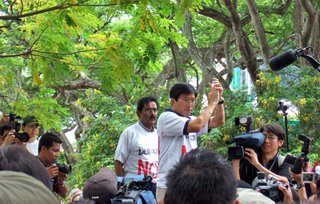
But as I approached the area i can see many police hanging around. They walked in pairs and were going around telling the people gathered to disperse or go home. The uncle in front of me was approached and not happy and said back "thank you for your advice, I want to walk around in the park cannot meh?!" Haha the mata diam diam and walked away liao. I sms Derek he also never reply... I think he humji kia see police only balls shrink liao, must have played me out... KNN so typical of Sporeans!
All over the place also got many plain clothes mata. They were easy to spot. For a Sat they were dressed a little too formal. Some of them got wear those earpieces or carry video cameras. They take pictures and video everything. KNN i think i sure tio liao, a yandao kia like me they sure jealous and zoom in on me one HAHAHA!!
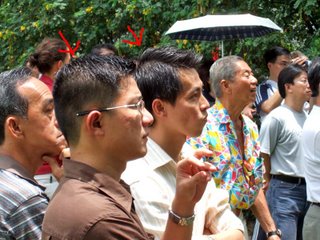 This two here try to act casual but they are quite nervous and fidgety. The one on the left keep twitching his fingers without realising it.
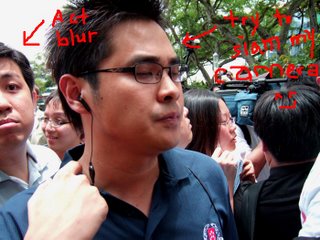
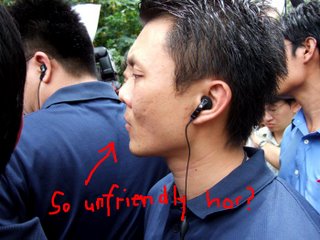
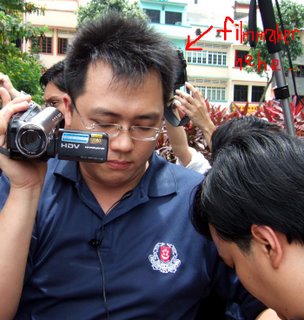
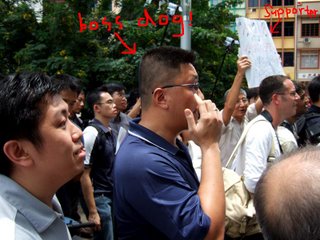
Haha so funny, when I went nearer SDP was singing birthday song to LKY. Apparently today is the despot's birthday! Hahaha! Check out this supporter's shirt ~~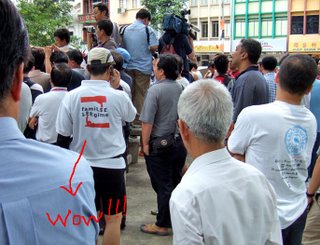
Anyway after a while Dr Chee and 4 others wearing T-shirts with democracy and freedom slogans decided to start their protest walk, and that's when I saw how the mata moved in on them.
The SDP did not break any law, therefore the police cannot arrest them. There was a large media presence, both local and foreign, so i think mata also a bit gan cheong. So what the police did was to break the law themselves! They forcefully formed a human circle around the group and just BLOCK the group from moving. They act blur and pretended never hear the appeals from Dr Chee and some members of the public asking them to DON'T BLOCK people from walking. Wah I must say the police behaviour is really damn disgusting. Others obviously felt the same and many were calling the police running dogs or poodle force and other names. Even when Dr Chee said he wanted to go home or this or that the poodles also refused to move. Wah lan really first world gahmen! So shamefull!!
I squeezed in and took a picture. Can see all the act blur faces? KNN got one mat poodle try to look tough hahaha! Who is he trying to scare?
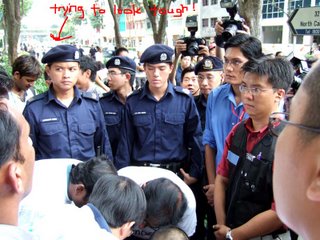
Later the SDP group managed to break out into smaller groups or individuals but the poodles continue to harass each and everyone of them. Here is Dr Chee's sister being surrounded and blocked by poodle bitches at Circular road.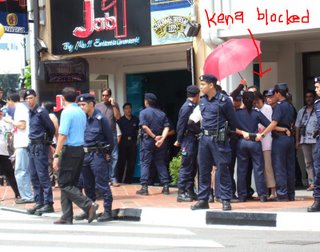
The SDP group was trying to make their way to Parliament House. Of course they failed. What they succeeded in attracting a lot of attention. Derek thinks that what the police did was clearly illegal (I found Derek amongst the crowd later). How can they behave the way they did? In order to please their masters they couldn't give a shit to their duties as civil servants. Instead they trample on and bully harmless and innocent S'poreans. At one stage i heard Dr Chee's sister wanted to go toilet and yet the poodles refused to let her go, so bloody ridiculous! Dr Chee himself never got out of Hong Lim park! The poodles blocked him all the way, really unbelievable.
At around 3pm lidat we ourselves buay tahan liao, sibei hungry so we left and went makan. When we left they were still stuck lidat, i wonder how long they will stay this way?
KNNBCCB wah lan i really feel sad for my country and dunno what to say. It is clear that the police is intruding into S'poreans rights and private space. Instead of protecting the citizens, they are protecting the interests of PAP gahmen and politicians. Everything that was once good in this country is now totally fucked and corrupted. Like what Derek likes to say "its gone to the dogs"... how very true.
Last night I did guard duty and only booked out this morning. Damn shag so just want to go home and sleep. But when I reached home Derek called me say want to go eat breakfast or not? Think think also can lah, so i quickly change and go meet him at Hong Lim hawker centre. There the food is sibei tok kong one.
But when I reach there hor, wah i see like got crowd gathered at Speakers Corner leh. This lan cheow place created by the wayang gahmen is usually like fucking ghost town lidat, how come today so happening?? So i go look see look see lah...
CCB recently in camp kena a lot of sai kang so very busy no time read newspapers... 原来 hor today Singapore Democratic Party is holding a rally and protest there. Can see Dr Chee giving speech some more. Wow! So exciting!

But as I approached the area i can see many police hanging around. They walked in pairs and were going around telling the people gathered to disperse or go home. The uncle in front of me was approached and not happy and said back "thank you for your advice, I want to walk around in the park cannot meh?!" Haha the mata diam diam and walked away liao. I sms Derek he also never reply... I think he humji kia see police only balls shrink liao, must have played me out... KNN so typical of Sporeans!
All over the place also got many plain clothes mata. They were easy to spot. For a Sat they were dressed a little too formal. Some of them got wear those earpieces or carry video cameras. They take pictures and video everything. KNN i think i sure tio liao, a yandao kia like me they sure jealous and zoom in on me one HAHAHA!!
 This two here try to act casual but they are quite nervous and fidgety. The one on the left keep twitching his fingers without realising it.


Haha so funny, when I went nearer SDP was singing birthday song to LKY. Apparently today is the despot's birthday! Hahaha! Check out this supporter's shirt ~~

Anyway after a while Dr Chee and 4 others wearing T-shirts with democracy and freedom slogans decided to start their protest walk, and that's when I saw how the mata moved in on them.
The SDP did not break any law, therefore the police cannot arrest them. There was a large media presence, both local and foreign, so i think mata also a bit gan cheong. So what the police did was to break the law themselves! They forcefully formed a human circle around the group and just BLOCK the group from moving. They act blur and pretended never hear the appeals from Dr Chee and some members of the public asking them to DON'T BLOCK people from walking. Wah I must say the police behaviour is really damn disgusting. Others obviously felt the same and many were calling the police running dogs or poodle force and other names. Even when Dr Chee said he wanted to go home or this or that the poodles also refused to move. Wah lan really first world gahmen! So shamefull!!
I squeezed in and took a picture. Can see all the act blur faces? KNN got one mat poodle try to look tough hahaha! Who is he trying to scare?

Later the SDP group managed to break out into smaller groups or individuals but the poodles continue to harass each and everyone of them. Here is Dr Chee's sister being surrounded and blocked by poodle bitches at Circular road.

The SDP group was trying to make their way to Parliament House. Of course they failed. What they succeeded in attracting a lot of attention. Derek thinks that what the police did was clearly illegal (I found Derek amongst the crowd later). How can they behave the way they did? In order to please their masters they couldn't give a shit to their duties as civil servants. Instead they trample on and bully harmless and innocent S'poreans. At one stage i heard Dr Chee's sister wanted to go toilet and yet the poodles refused to let her go, so bloody ridiculous! Dr Chee himself never got out of Hong Lim park! The poodles blocked him all the way, really unbelievable.
At around 3pm lidat we ourselves buay tahan liao, sibei hungry so we left and went makan. When we left they were still stuck lidat, i wonder how long they will stay this way?
KNNBCCB wah lan i really feel sad for my country and dunno what to say. It is clear that the police is intruding into S'poreans rights and private space. Instead of protecting the citizens, they are protecting the interests of PAP gahmen and politicians. Everything that was once good in this country is now totally fucked and corrupted. Like what Derek likes to say "its gone to the dogs"... how very true.
Thursday, September 14, 2006
Would you smile ...
if you are a IMF-WB delegate visiting this place??

The hypocrisy and fakeness of it all. Looks more like a prison than anything else. A bit scary even!
Uniquely Singapore... So sad isn't it?

The hypocrisy and fakeness of it all. Looks more like a prison than anything else. A bit scary even!
Uniquely Singapore... So sad isn't it?
Subscribe to:
Posts (Atom)